Kim Jong Un Signals Massive Missile Push for 2026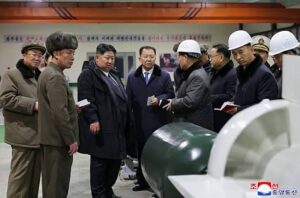
As 2025 draws to a close, North Korean leader Kim Jong Un has made it clear that the upcoming year will be one of unprecedented military industrialization. On December 26, 2025, state media (KCNA) reported that Kim has ordered a significant expansion and modernization of the country’s missile production capacity, calling for the construction of several new munitions factories.
This directive follows a series of high-profile inspections of defense facilities and comes just ahead of a pivotal Workers’ Party Congress scheduled for early 2026.
A “Busy Year Ahead” for Munitions Factories
During his recent visits to major munitions industry enterprises, Kim Jong Un emphasized that the “missile and shell production sector” is the backbone of the nation’s “war deterrent.” He instructed officials to:
Expand Production Capacity: To meet the “prospective requirements” of both missile and artillery forces.
Build New Plants: Construct additional munitions factories to keep pace with rising domestic and strategic demand.
Modernize Facilities: Shift toward high-tech, automated production lines to increase output efficiency.
Beyond Missiles: Submarines and Air Defense
The push for 2026 isn’t limited to ground-to-ground missiles. Just days before this announcement, Kim was reported overseeing:
Nuclear-Powered Submarine Progress: An inspection of an 8,700-ton nuclear-powered strategic submarine currently under construction.
Secret Underwater Weapons: Research into new maritime technologies designed to counter regional naval threats.
Advanced Air Defense: The successful test-firing of new-type long-range, high-altitude surface-to-air missiles over the Sea of Japan.
The Global Context: The Russia-Ukraine Connection
While North Korea frames this as a “deterrence” strategy against the U.S. and South Korea, international analysts see a different motivation.
“Pyongyang is likely to shift focus toward producing systems linked to potential exports to Russia—including medium- and intermediate-range missiles.” — Dr. Ahn Chan-il, North Korea Researcher.
With North Korea having reportedly sent thousands of troops and massive shipments of artillery shells to support Russia in Ukraine, the 2026 production surge is widely viewed as a way to fulfill its alliance obligations to Moscow in exchange for advanced Russian military technology and economic aid.
What to Expect in 2026
The Ninth Party Congress in early 2026 will officially unveil the Five-Year Plan for the nation’s military and economic development. Based on these year-end orders, the world can expect a North Korea that is more integrated into the global arms trade and increasingly focused on sophisticated naval and air defense capabilities.
Would you like me to analyze how this production surge might impact regional stability or provide more details on the upcoming 2026 Party Congress?